Your Dev Work, Documented and Encrypted
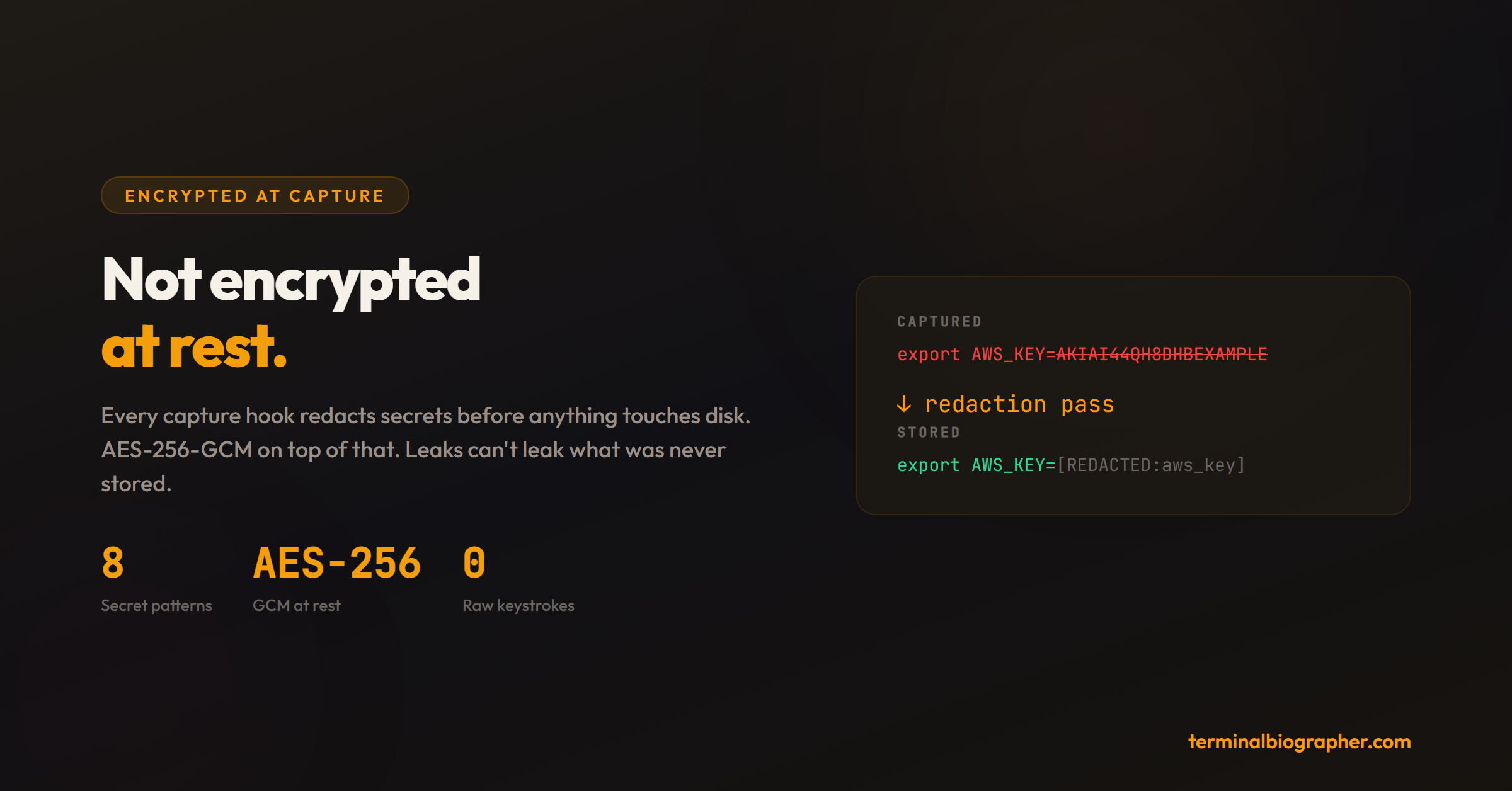
If you passively capture a developer's terminal and AI coding sessions, you face an immediate security question: what happens before an event touches disk?
In real-world development, engineers paste AWS access keys (AKIA...) into environment variables, test GitHub tokens (ghp_...) with curl, pass Bearer tokens in headers, and run database migrations with connection URLs. If any of those raw secrets make it into storage — even encrypted storage — a compromised laptop or backup becomes a credential leak.
Redaction at Capture, Not After
Every one of Terminal Biographer's 7 capture hooks runs event payloads through our redaction engine (tools/dwl/redact.py) inside the hook itself before serialization:
- AWS Access & Secret Keys stripped before leaving the shell hook
- GitHub, GitLab & Slack Tokens replaced with
[REDACTED]markers - OpenAI, Anthropic & API Bearer Tokens scrubbed across terminal and AI chat hooks
- JWTs, Private Keys & Database Connection Strings sanitized in-flight
Leaks cannot leak what was never stored.
AES-256-GCM + 12-Layer Local Security
After capture-time redaction, events are encrypted at rest with AES-256-GCM using locally derived keys (PBKDF2 600,000 iterations). The local FastAPI server binds exclusively to localhost:7749 with IP allowlisting, API key authentication, optional TOTP 2FA, and strict Content-Security-Policy headers.
Inspect the Security Architecture
Read our full 12-layer security specification or audit the MIT source on GitHub.
Explore Security Architecture